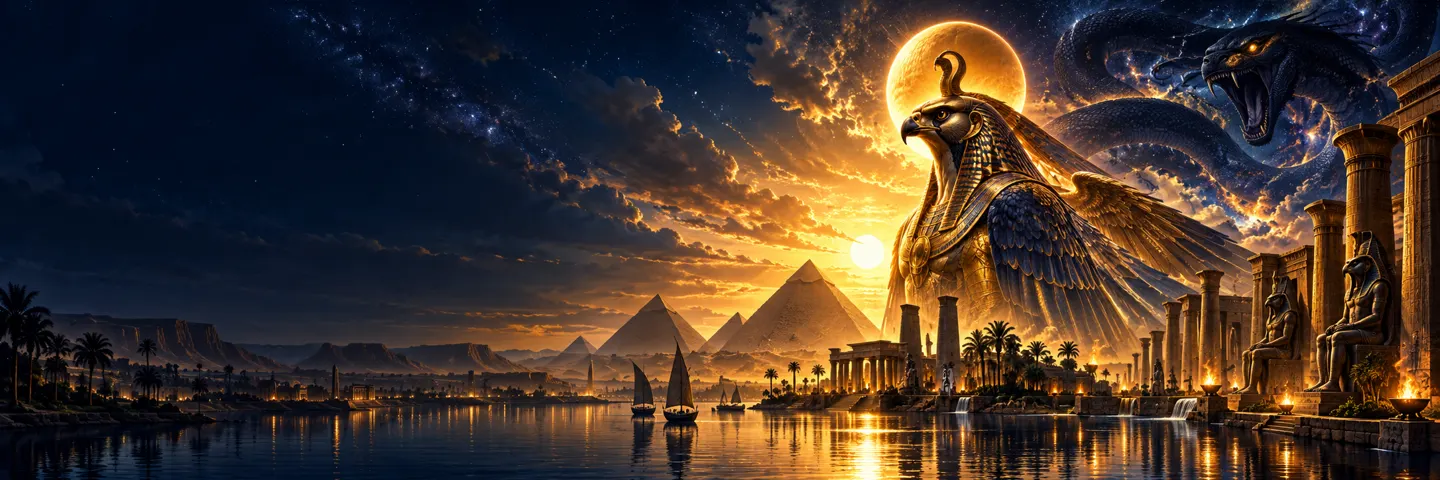
How the Nile and the sky organized time
Floodwater, agricultural rhythms and celestial observation shaped several Egyptian methods of marking days and years. The civil calendar, nighttime star clocks and religious narratives did different jobs. Exploring them together offers a vivid picture of Egyptian culture—but treating them as interchangeable historical birth horoscopes would go beyond the evidence.
Akhet, Peret and Shemu: three seasons
The civil year was organized into three seasons of four months each. Akhet referred to inundation, Peret to emergence and growth, and Shemu to harvest. Each month contained thirty days. Five additional days, added after the twelve months, brought the civil year to 365 days. These names preserve an agricultural frame of reference, although the calendar’s dates did not permanently align with actual seasonal conditions.
Why a 365-day calendar moves through the seasons
Unlike the later Gregorian calendar, the Egyptian civil scheme did not use a recurring leap day. Because the astronomical year lasts slightly more than 365 days, the civil calendar gradually shifted relative to annual celestial and agricultural events. The rising of Sopdet, commonly identified with Sirius, became an especially important subject for Egyptian calendrical study. Converting a modern birthday into one universal ancient Egyptian natal date without stating assumptions is therefore misleading.
Decans and the Egyptian night sky
Groups of stars called decans helped track nighttime hours. The Metropolitan Museum’s description of an astronomical ceiling based on Senenmut’s tomb shows constellations, protective deities and names of stars identified as decans. A sequence of civil ten-day periods can be a helpful educational feature, but these thirty-six calendar slots should not be equated automatically with thirty-six securely assigned individual natal stellar decans.
Ra, Apophis and Ma’at: a mythic language of renewal
Religious traditions tell of Ra’s solar passage and forces opposing the renewal of cosmic order, including the serpent Apophis. Ma’at represents truth, justice and right order; the British Museum describes her role in the weighing-of-the-heart story. These narratives were neither one fixed astrological technique nor a modern psychological questionnaire. They can, however, inspire clearly labelled contemporary reflections.
A modern educational journey through the Egyptian sky
ORACLASTRA uses a transparent educational 365-day model, illustrations of the Nile’s seasons and a symbolic narrative around Ra, Apophis and Ma’at. Its modern personalized layer is original editorial storytelling. The free experience is available now; a prospective full illustrated report should not be presented as purchasable before its validation.
Explore the Egyptian experience free →
Continue reading: Maya calendar explained · Viking runes explained.
Editorial note: Historical research, literary myth and ORACLASTRA’s modern symbolic creations are explicitly distinguished. Cultural traditions are diverse and should not be reduced to a single reconstructed “ancient horoscope.”