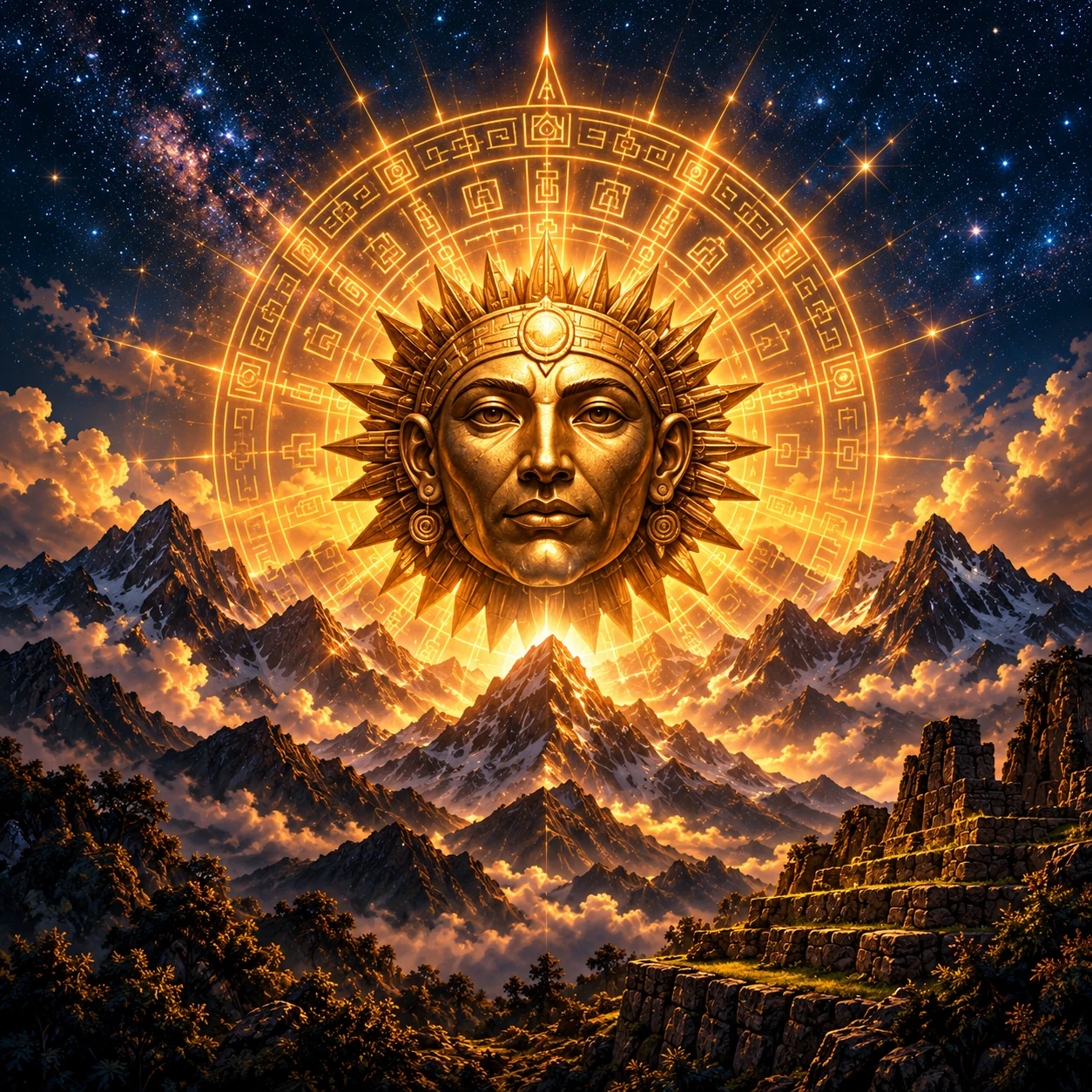
Why June is a seasonal turning point
In the Southern Hemisphere, the June solstice falls near the shortest days of the year. For agricultural societies attentive to horizon, weather and seasonal change, the Sun provides a powerful calendar. Scholarship on Inca astronomy examines solar observations, the year, the famous solar pillars of Cuzco and their relationship with social organization.
This is why the Sun is not decorative in an Inca-inspired calculator. It is historically relevant. But historical relevance is different from evidence for a natal horoscope, and ORACLASTRA keeps that boundary explicit.
Inti Raymi in historical memory
UNESCO describes Inti Raymi as a ceremony of Inca origin associated with the winter solstice and the opening of a new agricultural cycle. Colonial accounts, especially those attributed to Garcilaso de la Vega, became important sources for later understandings of the festival. Descriptions include days of ceremony, dance and offerings.
Those records are invaluable, yet they were written in colonial contexts and must be read critically. Historical reconstruction is rarely a perfect recording of a single unchanging ritual.
The modern Cusco festival was revived in 1944
A crucial detail is that the famous contemporary celebration in Cusco was re-established in 1944, drawing on historical narratives and modern cultural performance. UNESCO explicitly notes this revival. Today’s Inti Raymi therefore carries both historical memory and modern identity.
That does not make it “fake.” Living heritage is often renewed through performance, scholarship, community practice and reinterpretation. The key is not to claim that every costume, line or staging choice has survived unchanged since the sixteenth century.
Inti, imperial power and sacred landscape
Inca ritual linked the Sun with rulers, reciprocity, fertility and sacred landscapes. Museum research on Inca objects and ceremonies shows offerings, libations and state-sponsored ritual as part of imperial life. The sovereign’s role connected political authority with a wider sacred order.
Modern wellness language often turns this into “your solar energy.” That can be a creative metaphor, but it should not replace historical context. ORACLASTRA therefore uses solar symbolism as a contemporary interpretive layer rather than attributing modern self-help categories to Inca ritual specialists.
Why our calculator measures distance from the June solstice
The ORACLASTRA engine computes tropical solar longitude for a birth date and measures angular distance from the June-solstice point. This creates a consistent seasonal coordinate that can be reproduced for any date.
The metric does not mean an Inca priest historically measured a newborn as “36 days from Inti Raymi.” It is our modern way of locating a date within a cycle of light. The interpretation can talk about approach, culmination, harvest or return, while the method page makes clear where history ends and contemporary symbolism begins.
The four ORACLASTRA solar gates
For readability we group the solar circle into four symbolic gates: high Sun, harvest, Inti Raymi and return of the light. The names create a narrative rhythm suited to a Southern-Hemisphere solar frame.
These gates are ORACLASTRA’s design, not four recovered Inca zodiac signs. That distinction lets the calculator be evocative without manufacturing archaeological certainty. A strong symbolic product does not need to pretend its modern structure is ancient.
Explore your own solar position
Enter your date in the free Inca calculator to see your solar gate, approximate distance from Inti Raymi, Moon phase, dark-cloud figure and suyu. Read the combined synthesis rather than treating one metric as destiny.
You can also use The Circle of free calculators to explore other traditions. Each system has its own evidence, terminology and modern interpretive choices.
Astronomical solstice and cultural festival are not the same thing
The June solstice is an astronomical event that can be defined and calculated from Earth’s orbit and the Sun’s apparent position. Inti Raymi is a cultural, ritual and historical response to a seasonal turning point. The two are connected, but one should not be used as a substitute for the other.
This distinction matters in the ORACLASTRA engine. We can calculate solar longitude and angular distance from the solstitial point with astronomical consistency. The narrative meaning we give that distance — approach, renewal, harvest or return of light — is a modern interpretive layer. No source is cited as evidence that an Inca specialist produced natal readings using the same formula.
Why the 1944 revival matters
The twentieth-century revival in Cusco is part of the story, not an embarrassing footnote. Heritage is often carried through reconstruction, performance, scholarship, language and community practice. A modern revival can be culturally significant even when it is not an unchanged survival of every sixteenth-century detail.
For readers, this offers a useful model for approaching ancient-inspired astrology. Continuity and reinterpretation can coexist when they are named accurately. ORACLASTRA follows the same principle: documented historical context is preserved, astronomy is calculated, and contemporary symbolic writing is clearly identified as contemporary.
Verified sources
Editorial note: ORACLASTRA separates documented historical material from contemporary natal associations.